How the game got made
Everywhere else on this wiki, the game is taken apart from the outside. This page is the other half: who built it, what they built it with, and why it is shaped the way it is. It is assembled from developer interviews and community research rather than from the disc, so each claim is linked to where it came from.
It matters more than trivia. Several of the things this mod fixes are not mistakes - they are the visible edge of a project that lost its funding, restarted from scratch, and shipped anyway.
The studio existed to make this one game
Traveller's Tales set up an Oxford studio for the sole purpose of reviving Crash Bandicoot after Naughty Dog moved on. It shipped exactly two games: Crash Twinsanity in 2004, and Super Monkey Ball Adventure in 2006, after which the office was closed - reportedly because running a second site at that distance from the main Knutsford studio proved awkward to manage.
For a lot of the team, Twinsanity was their first commercial game. Before they had PCs at their desks they spent weeks playing the PS1 Crash games and reading Crash fan forums to work out what the series was supposed to feel like.
It was a different game first
The project began as Crash Bandicoot Evolution, a markedly more serious game:
- The Evil Twins steal Crash's island and graft it onto a planet built from pieces of other worlds - Crash's home as one jigsaw piece in a larger sphere.
- An alien ant invasion spreading across the galaxy.
- Foofie, an alien sidekick riding on Crash's arm, used to solve puzzles.
- A structure closer to an RPG/platformer hybrid, with The Legend of Zelda cited as a reference.
Then Ratchet & Clank shipped in 2002 with a strikingly similar planet-hopping premise, and Traveller's Tales scrapped Evolution and restarted production, this time aiming for the funniest possible Crash game rather than the most epic one. The deadline did not move.

Starting again from near-scratch against an unchanged ship date is why so much was cut late, why some cutscenes explain things that were never set up, and - most relevant here - why features like the cutscene skip ended up disabled rather than finished. See Cut and unshipped content.
Sixteen chapters, storyboarded
The disc's Extras gallery contains 161 storyboard pages, filed in sixteen sets numbered in the game's own chapter order - a record of what Twinsanity was planned to be, chapter by chapter, preserved inside the shipped product.

The distribution is lopsided. The first eight chapters have 103 pages between them, several with fourteen to
seventeen each; the last eight have 58, and 13-Twinsanity - the finale - has the fewest of any set at five.
The obvious objection can be ruled out from the disc itself. You would expect the thin sets to belong to chapters that
were cut, and so were never storyboarded properly - but Startup\LevelSelect.txt is a developer level-select list of
24 entries, and every one of them shipped. All sixteen storyboard sets map onto chapters that are in the finished
game. Five pages for 13-Twinsanity is five pages for a chapter you can play.
Suggestive, not proven. Page counts are not effort, and a short sequence can legitimately need fewer boards than a long one. But the shape matches everything else on this page: a project that spent its planning early and was finishing against a deadline by the end. It is unusual to be able to point at that from inside the disc rather than from an interview.
The name came out of a one-hour deadline
Working titles included Unlimited, Fully Fluxed and Twinsane. Publisher Vivendi eventually gave the team one hour to produce a final title, failing which the game would ship as Crash Bandicoot Unlimited. Concept artist Keith Webb came up with Twinsanity with about five minutes left.
The technology
This is the part that connects directly to the rest of the wiki.
| Engine | Nu2, Traveller's Tales' in-house technology. Not written for this game: the team started from the build used for Crash Bandicoot: The Wrath of Cortex and "gradually added new stuff and improved various bits" - some subsystems were never replaced. |
| Legacy code nickname | Programmers referred to the inherited parts as "Knutsford code", after Traveller's Tales' main studio. |
| Languages | "Mostly C++ with critical parts of the tech (like the renderer) hand written in assembler." |
| Gameplay scripting | An in-house tool called AgentLab. |
| Engine afterlife | Super Monkey Ball Adventure, the Oxford studio's next game, runs on the same engine and reuses some of Twinsanity's visuals and sound effects. |
Nu2, the engine with no name on the box
Twinsanity runs on Nu2 - the engine Traveller's Tales built for themselves and then used for nearly twenty years. Its reach is remarkable: every mainline Tt console and PC game from The Wrath of Cortex in 2001 through to The Lego Movie 2 Video Game in 2019 is the same engine, iterated. The LEGO games that Traveller's Tales became famous for are direct descendants of the thing Twinsanity is built on.

It is better described as a framework than an engine - a set of libraries rather than one monolith. The clearest
view of it comes from a sibling: Haven: Call of the King, Traveller's Tales' own 2002 PS2 game, shipped with symbol
names left in, and its executable is built from libraries called nucore, nu3d, numath, nusound2, nups2,
mp2play, gamelib, edtools and coblib. The source paths look like ..\nu2.ps2\nu3d\nuscene.c: a library tree
named for the engine, postfixed with the target platform, which is how the same code reached PS2, Xbox, GameCube and
PSP.

Two of those names are worth pausing on, because Twinsanity clearly has both: mp2play is MPEG-2 playback, which is
what the .PSS movies are, and edtools is editor tooling living inside the framework itself -
the family AgentLab belongs to.
Not from the binary. Twinsanity's retail executable is stripped - there is not a single nu2 symbol or source
path left in it, unlike Haven's. The attribution rests on two things instead: the developers' own statement that they
started from the Wrath of Cortex engine, and Wrath of Cortex being the first game on the documented Nu2 list; plus
the shared vocabulary below. It is an inference from a very short chain, not a string you can grep for.
The console was full
One number from this project's own reverse engineering says more about the conditions than any interview does. Twinsanity uses essentially all 32 MB of the PlayStation 2's memory: an 11.5 MB general pool and a 16.6 MB streaming buffer, leaving 8 KB of headroom. Adding 8 KB of new code to the executable does not shrink some slack - it breaks the boot outright, because the second allocation then overruns the heap.
The disc is packed the same way: not one spare sector between files. A bigger executable pushes everything after it along.
That is a game shipped exactly to the edge of its hardware, by a team that had already built it once and started again. It is also why this mod's own changes have to be paid for rather than simply added - the working code cave is funded by shrinking the streaming buffer by precisely the cave's size, so total memory use matches retail to the byte. The regression suite bears that out in practice as well as on paper: with the cave in place, every shipped cutscene skip behaves unchanged and load times are identical. The details are on The executable.
The Haven Rosetta stone
Haven is useful beyond its symbol names, because it shipped its scripts as plain text with the developers' own
documentation still in them. Its .flo files - "Game Flow" - are commented command scripts with semaphores used as
variables, GoTo / GoSub / Return, and commands like PlayLevelCutScene, WaitFade, PlayFMV, LoadLevel,
PreLoadLevel, SetCheckPoint and PlacePlayer.
Hold that next to Twinsanity and the family resemblance is hard to miss. This wiki's
glossary defines flow state as "the game's top-level state machine" - the same Nu2 term.
PlayFMV and LoadLevel are doing the jobs Twinsanity's PlayMovie and streaming loader do, and PlacePlayer /
SetCheckPoint are PosWarp's relatives.
The difference is authoring, not architecture. Haven shipped human-readable text the engine parses at runtime. Twinsanity shipped compiled state machines - AgentLab's output, conditions and commands reduced to numbers - which is exactly why Scripts opens by saying the game has no scripting language. It had one; it just did not put it on the disc.
The formats travelled too
The file formats are the hardest evidence of continuity, because a single community tool reads two games' worth of them. The Twinsanity Editor supports Crash Twinsanity and Super Monkey Ball Adventure, and its format list spells out what the extensions mean:
| Extension | What it is |
|---|---|
.RM2 / .SM2 | PS2 level resources / PS2 scenery resources |
.RMX / .SMX | the Xbox equivalents |
.RM / .SM | the PSP versions, from Super Monkey Ball Adventure |
.BD / .BH | the file archive and its index |
.MB / .MH | the music archive and its index |
That is the same resource system surviving a change of platform and a change of franchise. It also settles a
question this wiki got wrong for a while: .SM2 is scenery, not sound.
What came after
Nu2's PS2 sub-engine was "purpose-built for the PlayStation 2, and then ported and modified for use on other platforms" - it carried the LEGO games from Lego Star Wars through Lego Batman. When Traveller's Tales dropped PS2 support for Lego Indiana Jones 2 the engine was revamped into the Next-Gen (NXG) branch, which ran until 2019. Only with Lego Star Wars: The Skywalker Saga did they replace it, with a new engine called NTT - pronounced "entity" - and the studio has since moved to Unreal.
So the direct line from the disc in your drive runs: Wrath of Cortex → Twinsanity → Super Monkey Ball Adventure → Lego Star Wars → the entire LEGO catalogue.
AgentLab is still on your disc
The scripting tool's name is not just an interview footnote - it is shipped in the retail build. The archive contains a
folder literally called Language\AgentLab\, holding the on-screen tip text in all five languages, and the executable
references a file named Import\LevelAgents.axp.
That is also where this wiki's vocabulary comes from. The engine calls a live object an agent, the command that
changes an object's physical flags is SetAgent, and the state machines described on the
Scripts page are what AgentLab was compiling. When you write a recipe that edits state 7 of
COM_EARTH_WORM_START, you are editing AgentLab's output.
Because scripts, objects and instances kept the names the developers typed into AgentLab, the level files are far more readable than a stripped binary has any right to be. Nearly everything on this wiki was found by reading those names.
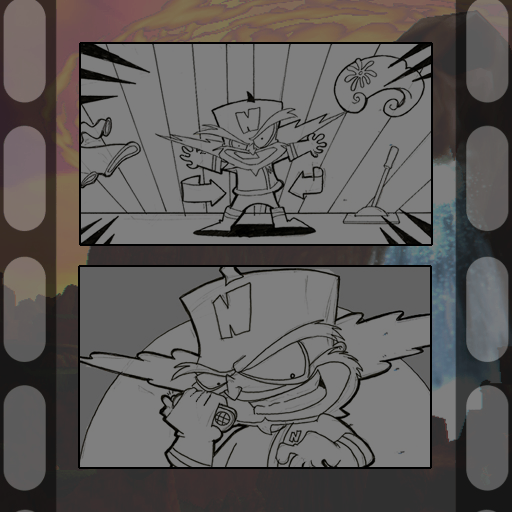
A storyboard from the N. Sanity set - the opening of the game being planned - as it ships in the disc's Extras gallery. Developers' artwork, not a capture of the game.
Who did what
| Role | Person |
|---|---|
| Traveller's Tales founder, set up the Oxford studio | Jon Burton |
| Director / producer | David Robinson |
| Designer | Paul Gardner |
| Lead artist | Dan Tonkin |
| Concept art, and the game's title | Keith Webb |
| Level design and enemy AI | John "J Mac" McCann |
| Lead character modeller | Chris Abedelmassieh |
| Writer | Jordan Reichek, of Ren & Stimpy |
| Voice director | Chris Borders |
| Music | Spiralmouth |
John McCann's own account is worth reading if you work on enemies: hired as a level designer, he ended up designing "about half of the levels in the game" and making "most of the core AI behaviours that drive all the enemies" - which is to say, most of the scripts this wiki decodes.
Before professional voice acting was cast, lead artist Dan Tonkin voiced Cortex in the early demos.
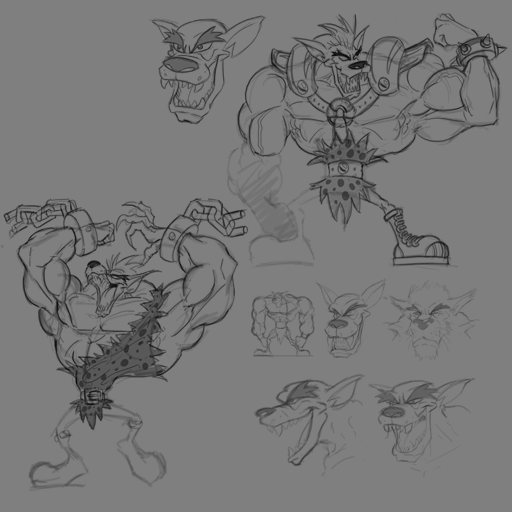
A character being worked out rather than a finished design - two poses, a head study, and a row of expressions. Also from the disc's Extras gallery.
Cortex changed voice
Clancy Brown, Cortex's voice since the PS1 games, left over video game voice pay. Lex Lang replaced him and was directed to play Cortex as flamboyant and self-absorbed rather than straightforwardly mean; Lang has cited Monty Python as an influence. It is the single biggest reason Twinsanity's Cortex reads as a comic lead rather than a villain.
The soundtrack has no instruments in it
The score was composed, performed, arranged and produced by the a cappella group Spiralmouth: every sound in the music is a human voice, with no instruments at all. It was recorded and mixed by Gabriel Mann at Asylum Recording Studios in Los Angeles.
Composer Rebecca Kneubuhl has described being given loose per-level guidance that kept shifting as the game changed, and an executive producer who never found anything too weird. Writing for voices instead of a band changes the composition from the start, not just the timbre.
There was also a more conventional option: an unused theme, a remix of the Crash theme used since Warped, credited to John McCann and later posted to Jon Burton's GameHut channel.
How it landed
- Released 28 September 2004 in North America, 8 October 2004 in Europe, 28 October 2004 in Australia, and 9 December 2004 in Japan.
- PlayStation 2 and Xbox. A GameCube port was cancelled, reportedly on the back of other Vivendi titles underperforming on the platform.
- Two separate mobile games followed in late 2004: an I-play title, and Crash Twinsanity 3D for 3G handsets.
- Reviews were mixed, averaging in the mid-60s. The open, connected world was welcomed after the corridors of The Wrath of Cortex; the camera, the controls and the checkpoint spacing were not. The a cappella score split reviewers completely.
- In the UK it entered the charts at #25 and stayed in the top 40 through Christmas 2004.
The sequel that never happened
There was no Twinsanity 2. Traveller's Tales pitched Cortex Chaos, in which a Cortex invention sucks Crash into television programmes, each show supplying its own environment and enemies. It was not picked up; the series went to Radical Entertainment and Crash of the Titans.
Paul Gardner's summary of Twinsanity is the one most of the team seem to share - a game "made with love", technically rough, handmade, and built by people trying to do right by what Naughty Dog left them.
Sources
- Crash Twinsanity Development - The Crash Bandi-pedia
- Crash Twinsanity - Wikipedia
- J Mac (Design) interview - Beyond Twinsanity
- Interview with Paul Gardner - Crash Mania
- Interview with Keith Webb - Crash Mania
- Interview with Rebecca Kneubuhl - Crash Mania
- Unused Content - Beyond Twinsanity
- Traveller's Tales Oxford Studio - MobyGames
- Engine - Traveller's Tales Lego Game Modding Wiki - the Nu2 lineage and its sub-engines
- Poking and Prodding Haven - Mark Sowden, TalonBrave.info - the Nu2 library list, the Game Flow scripts and their documentation comments
- Twinsanity Editor README - the format list across Twinsanity and Super Monkey Ball Adventure